Assess · Vulnerability scanning

Vulnerability scanning and assessment for Canadian businesses

Vulnerability scanning is an automated search for known weaknesses in the systems you expose to the internet: websites, servers, remote-access gateways and mail. We scan only targets you approve in writing, have a person confirm every result, rank what is real by risk, help fix it, and scan again to prove it is closed.

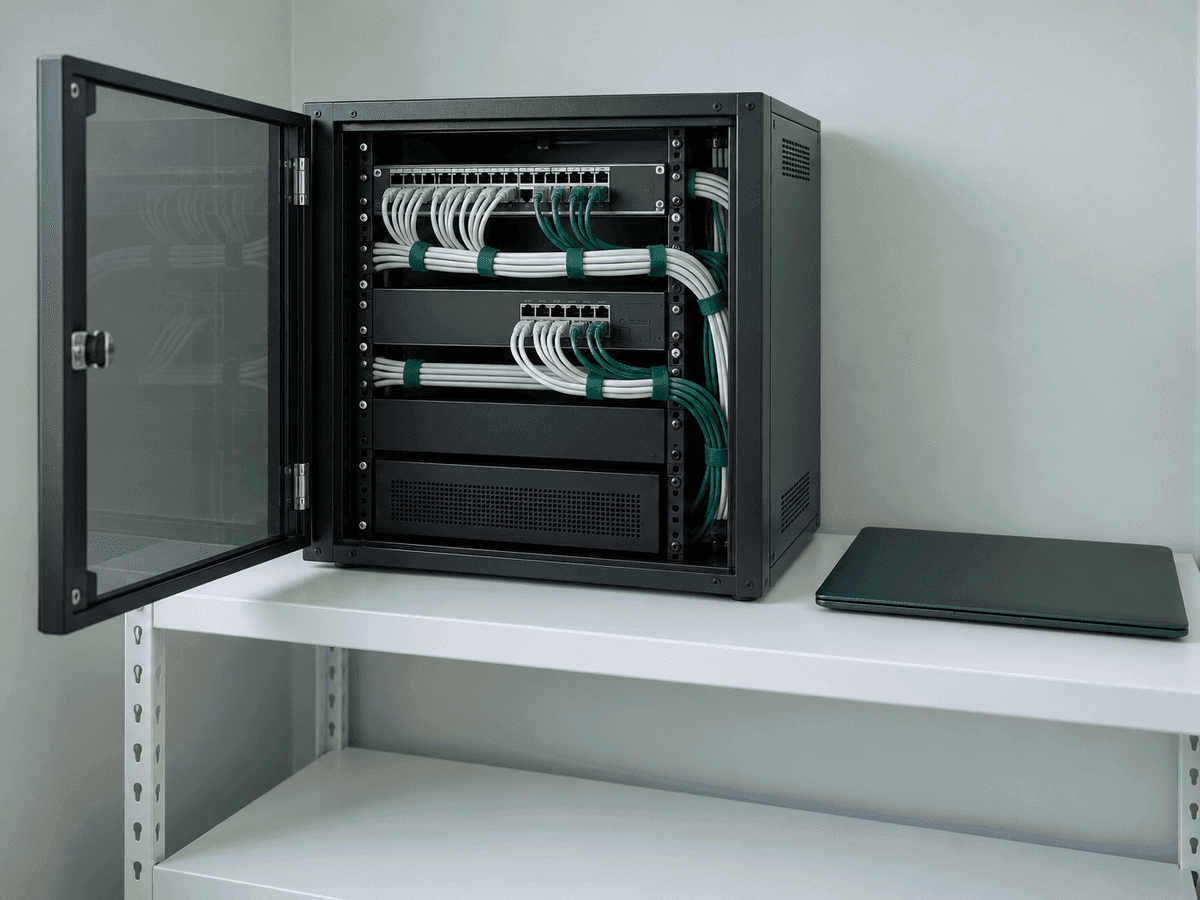
A small network cabinet on a white shelf, its glass door open, the cables tied in neat bundles with green straps, a closed green laptop beside it
Each round ends with a short report: what was found, what was fixed, what is left.

A person here calls you back the same business day, usually within an hour.

  • Written permission first
  • A report in plain words
  • Checked again after the fix

What vulnerability scanning finds, and where it stops

A vulnerability scan compares what your systems reveal to the internet against large databases of published flaws, so it is very good at spotting known, catalogued problems quickly and at scale. Typical results fall into five families, listed below.

A scanner reads versions, banners and responses; it does not reason about how your business works. Flaws in custom logic, a stolen password used from a normal location, a staff member tricked by a phone call, or two small weaknesses chained into a large one all sit outside what an automated scan can see. Those gaps are why a scan pairs well with a security audit and, for high-value systems, a penetration test.

  • Software with a published flaw: an old CMS, plugin, web server, VPN appliance or firewall firmware
  • Missing security updates on servers you can reach from outside
  • Admin interfaces left open to the whole internet: hosting panels, database tools, remote desktop
  • Weak encryption settings, expired or mismatched certificates
  • Default pages, sample files and directory listings that reveal how a system is built

Vulnerability assessment: every scan result is checked by a person

A vulnerability assessment turns raw scanner output into a short list of real problems, and that step needs a person. Scanners report false positives, repeat one issue across dozens of pages, and miss context: a flaw in a module you never switched on is a different matter from the same flaw on your login page.

The NIST Cybersecurity Framework 2.0 states the outcome plainly: vulnerabilities in assets are identified, validated and recorded.1 We treat the word validated literally. Each result is reproduced or checked by hand before it reaches your report, and anything we cannot confirm is either removed or marked as unconfirmed with the reason.

How findings are ranked: severity, exposure and known exploitation

Each confirmed finding gets a severity from the Common Vulnerability Scoring System (CVSS), the open standard published by FIRST; version 4.0 maps scores from 0 to 10 onto five ratings.2 FIRST presents the score as a measure of technical severity that organizations combine with their own factors when they assess risk.2

We add two factors of our own. The first is whether the flaw appears in the Known Exploited Vulnerabilities catalogue, which the US Cybersecurity and Infrastructure Security Agency keeps as a list of flaws confirmed to be exploited in the wild.3 The second is exposure: whether the system answers from the internet and what data sits behind it. Together they decide the band in which each finding lands.

  • Today: exploited in the wild, or critical and reachable from the internet
  • This month: high severity, or medium on a system that holds personal or financial data
  • Later: low severity, internal only, or blocked by another control already in place
CVSS v4.0 qualitative severity ratings
RatingCVSS scoreSource
Critical9.0 – 10.02
High7.0 – 8.92
Medium4.0 – 6.92
Low0.1 – 3.92
None0.02

Vulnerability management services: from a single scan to a regular cycle

Vulnerability management is the repeating cycle of discovering assets, scanning them, confirming and ranking results, fixing, and scanning again; one scan only describes a single day. New flaws are published every week, so a clean report ages quickly. CIS Control 7, Continuous Vulnerability Management, asks organizations to continuously assess and track vulnerabilities on all enterprise assets to shrink the window an attacker has.4

Canadian guidance points the same way. The baseline controls for small and medium organizations call for automatic patching or a full vulnerability and patch management program,6 and the Top 10 IT security actions ask that security patches be applied as soon as possible under your patch process.7 We run the same daily vulnerability check on our own servers and more than 80 websites, so the cycle below is one we work inside every day.

The scan can be a one-off assessment, or repeated on a schedule written into the scope letter. The diagram shows one turn of the cycle.

Discover the assets

An inventory comes first, since a scanner can only test what it is pointed at. CIS Control 1 and NIST CSF 2.0 both start from inventories of hardware, software and services.51 Forgotten subdomains and old test servers often turn up here.

Scan and confirm

The agreed targets are scanned within the agreed window, then a person reviews the output, removes noise and confirms what is real.

Fix and rescan

We apply the fixes ourselves or alongside your IT provider, then rescan each item so the report shows it closed, with the date.

1 Discover assets Domains, IPs, sites, remote access 2 Scan Agreed targets, agreed window 3 Confirm by hand False alarms removed 4 Rank CVSS, known exploits, exposure 5 Fix Today, this month, later 6 Rescan Closed items dated in the report
One turn of the vulnerability management cycle, from the asset list to the report.

External vulnerability scan and attack surface: what we look at

An external vulnerability scan looks at your business from the internet, the way a stranger would, and the attack surface is the full list of things that answer from outside. For most small businesses that list is longer than expected, because services added years ago by a former provider are still running.

Attack surface management means keeping that list current and shrinking it: switching off what nobody uses, putting admin panels behind a VPN or an allow list, and making sure every remaining service is patched. The targets are always named in the scope letter; servers inside the office network can be added when the letter covers them.

  • Your domains and the subdomains published in DNS
  • Public IP addresses of the office, the hosting account and cloud servers
  • Websites and online stores, including the CMS and its plugins
  • Mail servers and webmail login pages
  • VPN gateways, remote desktop and other remote-access entry points

Vulnerability assessment and penetration testing: how they fit together

A vulnerability assessment lists the known weaknesses across many systems; a penetration test takes a few targets and tries to exploit them, to show what an attacker could achieve. The assessment is broad, repeatable and suited to a regular schedule. The test is deep, done at a point in time, and usually ordered for a specific system or because a contract requires it.

The two are often sold together under the label VAPT. For a small business the sensible order is assessment first, fixes second, and a penetration test once the easy entry points are closed, so the tester spends paid hours on the hard questions. Penetration testing is arranged on request with its own scope.

Dark web monitoring and leaked passwords

Dark web monitoring searches leaked databases and criminal forums for email addresses and passwords tied to your domain, and alerts you when one appears. It tells you that a credential was exposed somewhere; it cannot tell you whether that password still works or where it is reused.

The protective steps are the same whichever source reports the leak: reset the password, turn on two-step sign-in, and check the mailbox for forwarding rules someone else may have added. Those account checks are part of our security audit, and a mailbox tampered with to send fake invoices is covered by email security.

Why a contracted team: the risks of doing it alone, with a chatbot or a freelancer

Free scanners are easy to run and hard to read. A first report often lists hundreds of items, many of them false alarms, and a team without time to confirm each one either fixes the wrong things or gives up on the list.

A chatbot can describe a CVE number in fluent prose, yet it has never seen your server, cannot confirm whether the flaw is reachable, and does not carry responsibility for the advice. Copying scan results, internal addresses or configuration files into a public tool also hands that map of your weak points to a third party.

A freelancer with a scanner may run a sound scan, though scanning systems without the owner’s written permission can breach a hosting contract or the law, and a person working alone rarely stays for the fixes and the rescan. Aggressive settings on a live store or booking system can slow it down at the worst hour.

A contracted team scans only what the signed scope letter names, confirms each finding by hand, carries commercial general liability insurance, and closes the loop with a rescan that you can show to an insurer or a client.

Five plain reasons to trust us with this

  • A registered Canadian company

    INNOVA CONSULT LTD., federal corporation 1522612-1, based in Ottawa. itopsi is its brand.

  • In practice since 2013

    The group behind itopsi has run legal and marketing practices since 2013. Its founder has worked in law and compliance for more than 14 years.

  • We run servers of our own

    Our own servers and more than 80 websites are checked for known vulnerabilities every day.

  • Insured

    Commercial general liability insurance of CAD 1 million is in force.

  • Your scope, your report

    A fixed scope in a signed letter before any work starts. Licences and equipment at cost, with no vendor commission. The report belongs to you.

How the work goes

Five steps, in the same order every time.

Before any test, you sign a scope letter: what we test, on which dates, who to call, and what we must leave alone.

Your signature comes first

  1. Step 1

    We agree what to check

    A short call, or the form at the foot of this page. Together we decide which website, server or office systems we look at.

  2. Step 2

    You sign the scope letter

    It sets the targets, the dates, the contacts, and what we must leave alone. Work starts only once it is signed.

  3. Step 3

    We check, and write it down

    One report in plain words for you, with the technical detail attached for whoever looks after your systems.

  4. Step 4

    We fix it

    We make the repairs ourselves, or together with your current IT provider or web developer.

  5. Step 5

    We check again

    A second check confirms that each problem is closed.

What it costs

Each job is a different size, so each one gets a fixed quote once the scope is agreed. You see the price in writing before any work starts.

  • A fixed quote once the scope is agreed
  • The price in writing before work starts
  • A second check after the fixes
Questions

Questions owners ask us

Your question is missing? Leave your number and ask it in your own words.

How often should we scan for vulnerabilities?
Public guidance sets no single interval: CIS asks for continuous assessment and the Canadian Centre for Cyber Security asks for patches as soon as possible. For most small businesses a monthly external scan, plus one after every significant change such as a new website, server or firewall rule, is a sensible starting point. The schedule you choose is written into the scope letter.
What is the difference between a vulnerability scan and a penetration test?
A scan is automated and broad: it checks many systems for known, published flaws and is repeated regularly. A penetration test is manual and deep: a tester tries to exploit a few chosen targets to show real impact. The scan tells you what is open; the test shows how far someone could get through it. Most businesses start with scanning and fixing.
What does dark web monitoring actually find?
It finds your company email addresses, and sometimes passwords or password hashes, in breach dumps and on criminal forums, usually leaked from a third-party site where staff used a work address. It cannot see inside your systems or confirm the password still works. Treat every alert as a prompt to reset the password and turn on two-step sign-in.
Will scanning slow down or break our systems?
A scan sends many requests, so a fragile or overloaded system can slow down. We agree the targets and a time window in the scope letter, use gentle settings on live production systems, and keep your named contact informed. If a system reacts badly, we pause that target and call your contact before continuing, and busy hours for a store or booking system are avoided.
What happens when a critical vulnerability is found?
We contact your named person right away, without waiting for the final report, explain the risk in plain words and propose either a fix or a temporary measure, such as closing a port or restricting an admin page. Once the fix is in, we rescan that item and record in the report that it is closed, with the date.
Do you need access to our network to run the scan?
An external scan needs no passwords: we test what the internet can see, from outside, after you approve the target list in writing. Scanning servers inside your office network, or a scan that logs in to see deeper, needs either temporary access or a short session with your IT provider. Every target and method is listed in the scope letter before anything starts.
How much do vulnerability assessment services cost?
The price depends on how many domains, IP addresses and websites are in scope, whether internal servers are included, how often the scan repeats, and whether you want us to apply the fixes. After a 30-minute conversation we put a fixed price in the scope letter, and it holds for as long as the scope stays the same.

Tell us what worries you.

Leave your name and a number. A person here calls you back the same business day, usually within an hour, and asks what you want checked. Would you rather start on your own? The free audit takes about three minutes.

  • Same day callback
  • Written permission first
  • Fixed quote

Ask us to call you back

Leave your name and number. A real person calls you back the same business day, usually within an hour.

We use your number to call you back about your request. Nothing else.

Call me back